Friday, May 12, 2017

Immigrant Song

I was born in Bhopal, India.  In 1984, Bhopal was the site of the Union Carbide gas leak.  At least 5,000 people died, making it the worst industrial accident in history.  I have always taken a perverse pride in being born in Bhopal, as if by leaving I narrowly averted disaster.  So much of your life is determined by the circumstances of your birth.  My parents and I lived in a modest flat, a tidy house with a small yard.  My father was an electrical engineer.  I remember waiting for him when he came from work so I could ride on his scooter.  Since we were too poor to have domestic help, my mother spent time all her time cooking, cleaning, and doing the washing by hand.  I was toilet trained at eight months, before I could walk, to cut back on the diaper burden.

My life in Bhopal was book-ended by trips to extended family.  I was the eldest daughter of the eldest son of the eldest son, a position of great privilege.  During my early years, I was doted on by grandparents, aunts, uncles, cousins, and servants.  I thought myself the center of the universe, possessing all-encompassing power and unconditional love.  My paternal grandfather was a devoted gardener.  I ran amok in the vast gardens of the compounds, climbing guava trees, eating mangoes, chasing chickens and dogs.  The maternal compound involved roaming around a massive stone edifice, a building full of art and surrounded by exuberant bougainvillea.  This was my young life.


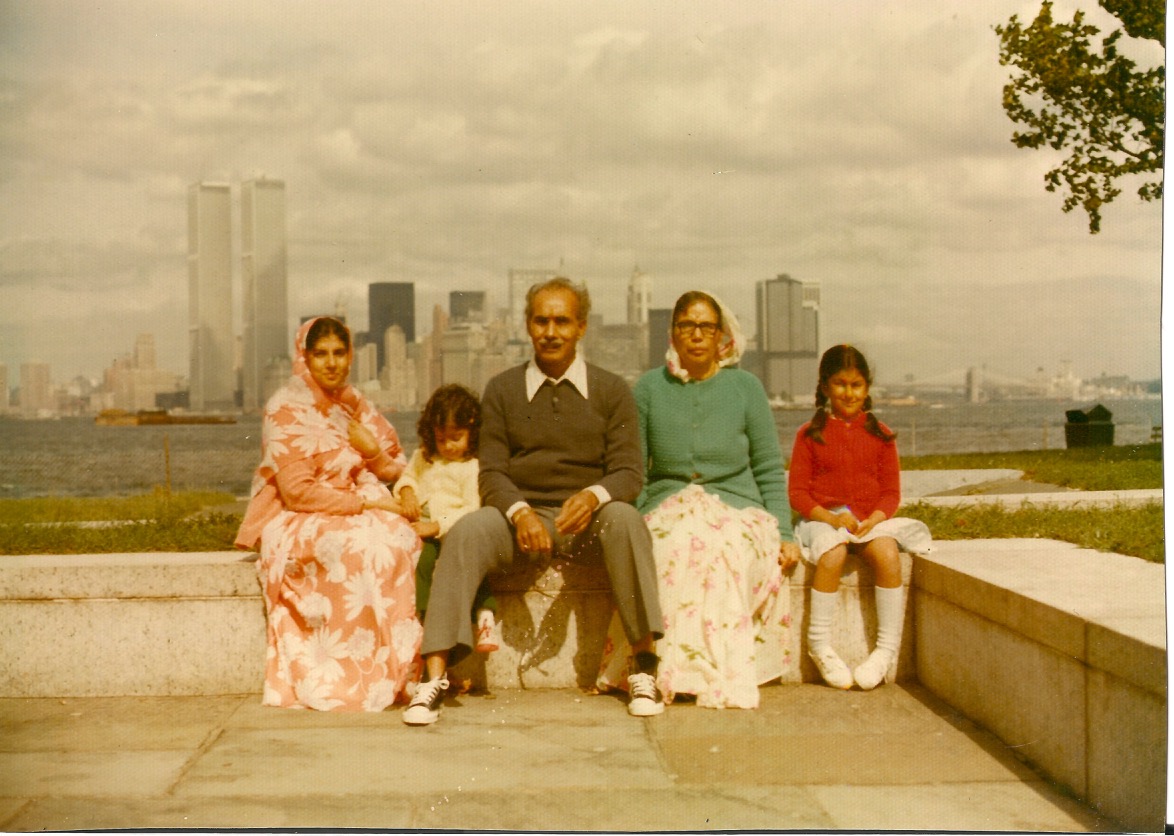
My first memory of America was the International Arrivals terminal at JFK.  I was four years old, clutching my mother’s hand as we disembarked from the Air India flight.  I don’t remember the Trans-Atlantic flight, which surely must have been a long, strange trip.  I remember the arrival.  I felt very small in the huge hall as I looked up at the balcony lined with international flags.  I remember seeing my father waving from above, and I waved shyly back.

My father had left India ten months earlier, a beneficiary of the Hart-Celler Act (aka the Immigration and Nationality Act of 1965.)  This radical piece of legislation was proposed during the Kennedy era and passed during the Johnson administration.  The Act abolished the national origins quota system, opening immigration to non-European nationals.  Priority was given to those from countries affected by war and civil strife (e.g. Cambodia and Vietnam in the 1970s).  The Act also gave preference to certain in-demand professions such as scientists, engineers, and physicians.  Many Asian Americans can trace their roots to the immigration that occurred during this time.  While this migration led to a brain drain in much of Asia, it led to great scientific and technological advancement for the US.

My father had long dreamed of coming to America.  His application process had been expedited by his grandfather, who gave him money surreptitiously and helped him take out a government loan with family property as collateral.  My father was issued a green card on his arrival in New York City.  This card gave him permanent residency in America.  He quickly found an engineering job at American Electric Power on Staten Island.  He had a view of the Hudson River as he worked 10 hour days (with mandatory overtime.)  He rented an apartment in Flushing, Queens.  He and a friend bought a used Impala from the landlord, and my father paid an additional $15 a month in parking fees to the same landlord.  He became part of a community of recently immigrated young Indian engineers.  My father tells stories of their efforts to adapt to this strange country, such as when they tried to boil a turkey on Thanksgiving.  I think their first Thanksgiving meal consisted mostly of beer.

My father is not a foodie, and he lived on white bread and American cheese.  In his first month in America, he developed a boil on his neck.  As he had neither the time off to make a doctor’s appointment nor the health insurance to pay for it, my father used homeopathic remedies which healed the boil.  Thus began his lifelong love affair with homeopathy. My father considers himself the original “Dr. Singh.”  He is nothing if not a frugal man, and he quickly saved enough money to bring my mother and me to the States.  He was first in line at the Indian embassy at 2:00 a.m. so that he could apply for our visas before heading to work.

My mother and I arrived in December.  When you are an immigrant, there is the life before and the life after the move.  And everything is different between the two: the language, the food, the weather, the customs, the people.  Many writers have written about this sense of disorientation and displacement.  Jhumpa Lahiri describes the Indian immigrant experience in her work (see “The Third and Final Continent” from Interpreter of Maladies.)  Her images are poignant—the sari dragging in the snow, the loneliness of young wives separated from their families, the small Hindu deities in home shrines.  These are images I remember from my own life.


In India, there had been two seasons: the summer (dry heat) and the monsoon (wet heat.)  Snow came as a shock.  In America, I always felt cold despite the boots and a winter coat.  We lived in an apartment on Stanford Avenue in Queens, surrounded by concrete and crowds.  There were no expansive gardens and orchards to run around in.

I have a few other visceral memories of my early American life.  I got the mumps shortly after we arrived.  There were no vaccines in India, and my parents had not known to get them in the US.  I can still feel the pain of the swollen glands as I cried in my mother’s lap, holding my head in my hands.  I remember a boy sitting next to me in the cafeteria eating salami and blowing his breath in my face.  I remember getting lost in Rockefeller Center when my father took me to see the Rockettes.  I remember seeing my father only on weekends, as during the week as he would leave for work before I woke up, and he came home after I was asleep.  I remember the strangeness of not seeing my extended family.  I remember making toast and tea for my nauseated mother when she was pregnant with my sister.  I remember her silent sadness which I could neither understand nor erase.

Even in the culturally diverse neighborhood of Queens, I was a stranger in a strange land.  I was not black; I was not white.  My mother tells a story of us passing a group of people and my asking, “Are they laughing because we are Indian?”  I was baffled by American behavior and language.  One time in kindergarten we were told to line up.  I stood behind a girl wearing a halter top.  I was fascinated by this outfit that exposed her bony shoulder blades.  I tapped her scapula and asked why we were standing in line.  “Assembly,” she replied curtly.  “Oh,” was my response.  “You don’t even know what assembly is,” she said as she whipped back around.  She was right.  I fought back the hot tears of shame.  I would ask about that word when I got home.  And every other word I didn’t understand.  There would be many strange words in this language: galoshes, catechism, auditorium, smock.

As I grew up I recognized that despite being educated in English medium schools, my parents retained their accents.  They were not always understood by native speakers.  I remember my mother asking the school for the lunch “me-nu” or my father asking for a “fill-up” at the gas station, their requests being met by baffled stares.  I could understand my parents, why couldn’t other people?  I was fortunate that both my parents were literate in English.  My mother read to me.  I watched hours of Sesame Street and soap operas.  I had access books at home, from my precious Little Golden Books to the Big Book of Science.  I had learned to read and write in Hindi before I came to America, and I quickly became proficient in English.

In first grade, we were required to bring books to read in class.  I always had a book with me but there was a young boy who was usually empty-handed.  I can still see Louis with his big brown eyes and an open, pleasing face.  In retrospect, I suspect his name was Luis.  He didn’t speak English, and he was scolded daily by the teacher for not bringing a book.  One reading period I saw him pull a book out of his backpack.  He looked so proud.  The teacher saw him with the book and accused him of stealing it.  I wanted to intervene, to say, “No, that is his book.”  But I didn’t.  And again I feel the hot tears of shame on my face.  I regret that I kept silent.  Perhaps I was shy or afraid or uncomfortable.  That is no excuse, and I have since learned to use my big girl voice to speak up.

I didn’t consciously set out to master the English language.  I just happened to read voraciously, to the exclusion of all other activity.  I would read anything I could find:  magazines and manuals, novels and dictionaries.  My social life revolved around libraries and bookmobiles, great equalizers of public education.  I did well in English classes and had inspiring teachers.  I ultimately majored in English in college and went on to earn a master’s degree in English and comparative literature.  I recognized early that language is power.  And that those with power have a responsibility to advocate for those who are vulnerable.


We moved away from Queens when I was 7, escaping in our Vista Cruiser station wagon to the suburban oasis of Ann Arbor, Michigan.  We lived in Ann Arbor a couple of years before moving to Gaithersburg, Maryland.  We would move back to Ann Arbor a couple of years after that.  I attended five different elementary schools in six years.  Each move was a mini-migration: new teachers, new classmates, new playgrounds.  Naturally introverted, I was forced to be bold.  Fear was a luxury I could not afford.  I needed to make new friends and learn new rituals as I settled into yet another climate.  This adaptability has served me well as I navigate the world.  The frequent displacement also left me with an existential restlessness.  I am perpetually searching for belonging, for community, for home.

These early memories are the micro-traumas of a five-year-old child, told in retrospect by a middle-aged woman.  Every immigrant has a unique story, one which involves saying goodbye to one life and awkwardly embracing another.  My origin story pales in comparisons to the suffering and sacrifice many immigrants have endured.  Life is not fair.  Wealth and health and human rights are unevenly distributed in the world.  The world has always been full of immigrants and refugees, fleeing tyranny, seeking security and health for their families, hoping to live and worship as they please.  We all want the same things.

In addition to the billion Indians in India, there are countless more dispersed around the globe.  This is the Indian diaspora: the IT prodigies on the campuses of Microsoft and Amazon, the manual laborers in the Middle East and Africa, the shop keepers and motel owners, the doctors and the scientists.  When one Indian recognizes another, there is often eye contact and a slight nod.  Perhaps it is the subtle acknowledgment that we share similar struggles, aspirations, and culture.  We have eaten the same food, recognize our music, laugh about Bollywood movies.  Whether it is the Sikh Uber driver who teaches classical Indian music, or the Fijian hospital workers who share their food, or the Mauritian surgeon who wants me to mentor his daughters, we seek connection within this diverse tribe.

Immigrants face a constant struggle between assimilation and preserving their cultural identity.  Some immigrants keep their heads low, work hard, and try to blend in.  They sense that acceptance is tenuous and can easily be taken away.  America has always had a problematic relationship with its settlers.  This country has prospered on the labor of both willing and enslaved immigrants.  American democracy has been built on shaky ground.  The values of life, liberty and the pursuit of happiness were meant for a select few.  The Constitution was written for and by white men, when Blacks were property, and women weren't even acknowledged.

The current American president has unequivocally denounced immigrants and refugees as threats to the American way of life.  Every day there are more deportations.  I have started carrying my passport and a copy of my naturalization papers.  Anger and xenophobia have led to an increase in hate crimes against minorities.  Recently a young Indian engineer was killed in Kansas.  He was simply having a drink with another immigrant friend.  He left behind a young wife.  This could have been my parents.  Despite this threat of violence, I refuse to be intimidated or keep my head down.

My father’s success can be attributed not only to his perseverance, but also to his grandfather's support and to a progressive US administration.  Talent alone is insufficient; there must also be opportunity.  I have benefited from internships and scholarships which allowed me to attend boarding school, an Ivy league college, and medical school.  My teachers encouraged me to be better, to think bigger, to overcome barriers.  How else could a girl child born in Bhopal become an orthopedic surgeon?

It remains to be seen what the future holds for the American political system, whether it can survive the current climate of polarization and divisiveness.  Democracy is a fragile thing.  I am slightly heartened by the appropriation of its ideals by the Canadian, Scandinavian, and mon dieu!, perhaps even the French.  So much of your life is determined by the circumstances of your birth.  I am grateful to have been born in the right place, at the right time.


Sunday, January 29, 2017

There is a Crack in Everything


There is a crack in everything.  That’s how the light gets in.
“Anthem”  Leonard Cohen

The last few mornings the sunrises have been extraordinary.  The colors of blue-pink-orange linger over the mountains; the lights on the bridge shine the way onward.  Despite the ugliness of the Trump administration, beauty still exists.  It is the light driving out the darkness.

The last week—has it only been a week?—has brought an onslaught of horror.  Executive orders against refugees, immigrants, Muslims, Mexico.  Orders building pipelines, erasing mention of climate change, denying freedom of speech and health care rights.  And each act has been met with resistance.  Trump has been fought in every possible way, with tweets, emails, legal actions, in personal meetings, and phone conferences. There have been protests and record breaking marches.  In short, his actions have been met with public outrage.  This uproar has not been by elected officials, who by and large have been shamefully silent.  This has been common people, the true stewards of democracy.

Airports have been shut down, taxi drivers have gone on strike, roads have been blocked.  This movement has become an opportunity for everyone to speak out, to exercise their rights however they can.  People who have never been “political,” who have never taken any political action, have found their voice.  How many of us have written letters, made phone calls, mobilized our friends and family?  This is a chance for people to demonstrate their power and their passion, and share their decency and respect for one another.

And again Leonard Cohen’s Suzanne rings true, “And she shows you where to look among the garbage and the flowers/There are heroes in the seaweed, there are children in the morning.”


And if you are wondering what you can do, here is just one link:  How to fight Donald Trumps Muslim ban

Saturday, January 21, 2017

View from the Roof of the World

Every volunteer assignment is an opportunity for adventure.  Tibet is the land of legends.  It is the fabled Shangri-La, the roof of the world.  But you cannot get there directly; you must first go through China.  I had gotten my first taste of Chinese bureaucracy when I had applied for the Chinese Visa, which is a prerequisite for getting a Tibetan permit.  And you cannot get a Chinese Visa if you mention going to Tibet.  During a brief visit to New York City, I visited the Chinese Embassy­—a massive, ugly, well-guarded edifice on the West Side Highway. I dutifully presented my documents, in duplicate as specified.  I had the passport pictures, the money order, the plane and hotel reservations which only listed sites in Chengdu and Beijing.  And because I was respectful and obedient, I could return two days later to collect my stamped passport. I am welcome to visit China for the next ten years.

Flying from Yangon to Chengdu involved a layover in Kunming, where I had to go through immigration and customs for the first time; I would do so again in Chengdu.  The female immigration officials came straight out of David Bowie’s “China Girl,” with their severe haircuts and snug outfits.  "China Girl" was one of my two earworms in the country, the other being Gang of Four’s “I Love a Man in Uniform.”  Flights in and out of China were invariably delayed.  The layovers involved everyone getting off the plane, cramming into an airport bus, driving around the tarmac, and then getting back onto the same plane.  It was literally an exercise in wasting time.

My first stop in China was Chengdu. My guide was a pleasant young woman named Shannon.  Her round glasses and short black hair reminded me of Marcie from the Peanuts cartoon. I kept expecting her to call me “Sir.”  At 14 million people, Chengdu is the fourth largest city in China.  If you have any doubt that China is the great imperial power of the 21st century, this city will promptly school you.  The buildings are massive, built in a Communist institutional style which emphasizes function over form.  Manhattan’s avenues seem positively provincial in comparison.  The highways were congested, filled with cars, bicycles, and motorcycles. Bikers wore anti-pollution face masks but not helmets.  And to stay warm, many riders donned backwards jackets that looked like a combination of quilted apron with oven mitts.

The shopping malls downtown were packed with young people, socializing, shopping, and eating.  At Shannon’s recommendation, I stepped into a doorway next to a Zara store.  I found myself in a hidden alley, full of lanterns and jade shops and carvings.  There was a food court with skewers and bowls and spices.  I was armed with my dietary preference card which had Mandarin translations for vegetarian food. No fish. No meat. Tofu, beans, dairy, eggs okay.  I was enticed by the sizzling spice of Sichuan cuisine with all those red-hot chili peppers.  I finished dinner with lips burning and tongue tingling.  But I was not here for the food.  I was here for the pandas.

Shannon and the driver picked me up early from the hotel, and we drove 90 minutes to the Dujiangyan Research Center of Giant Panda Breeding.  Shannon informed me I was going to be a volunteer “Panda Keeper.”  As with most of my volunteer activities, I was paying for the privilege.  When we arrived at the center, I changed into a utilitarian blue jumpsuit and got to work.  My role was to pick up the panda poop within the walled enclosures.  Two other volunteers washed the pens and gathered bamboo.  The guides warned that the Head Keeper was a strict woman, one who could be harsh with the volunteers. She warmed up to us, however, and allowed us extra time to hand feed the pandas and touch their paws.  We fed them apples, bamboo, and panda cakes.  Bamboo is not very nutritious so their diet is supplemented with the cakes which consist of grains such as wheat, rice, and rye.

We saw a movie about pandas, their lives and their loves.  Pandas are not very energetic and don’t have much of a sex drive.  The females are in heat only two days a year. Hence the need for a breeding center, one which monitors their cycles and encourages socializing at the appropriate times. Between loss of habitat, poor dietary choices, and lack of social skills, it’s amazing there are any pandas left at all.  They survive because they are cute, with their contrasting colors, large heads, and disproportionately small eyes.  Humans spend a lot of energy, time, and resources in panda preservation.  After I spent the day cleaning panda poop, breaking bamboo, making panda bread, and feeding pandas by hand, I got to cuddle a baby panda.  She couldn’t be bothered with me, focused as she was on eating, but it was a thrill nonetheless.


"A person can change.  Everything can change."
Marilynne Robinson  Home

My next stop was Lhasa, a short flight from Chengdu.  I stayed in the Shangri-La Hotel where most of the guests were Chinese.  The hotel had an in-house doctor and an “Oxygen Lounge” to assist with the altitude problems that can arise at 11,000 feet above sea-level.  People not accustomed to altitude can suffer from nausea and vomiting, headaches, shortness of breath, insomnia, and extreme fatigue.  The hotel was filled with elderly people walking gingerly, looking miserable, sipping on tea.  The heart can race, trying to compensate for the decreased oxygen content by pumping more furiously.  Paradoxically my heart rate slowed, holding at a steady 60 beats a minute.  Despite the outdoor temperatures being quite cool (around 30-40 degrees Fahrenheit), I felt flushed much of the time.  I wasn’t sure if I was going through menopause or malaria, but then I realized the thermostat in my room was broken.

To visit Tibet as a solo traveler, one must have a formal itinerary and state-approved guide.  Nyima (“pronounced like Nemo the fish”) was my Tibetan guide, and he spoke excellent English.  He and Dawa, our non-English speaking driver, were my good natured and steadfast companions for the 9-day visit.  Nyima shared his story with me.  He was born into a poor illiterate family in a village outside of Lhasa.  He was expected to be a shepherd like his older brothers, but apparently lacked the aptitude. At age 17 he joined a monastery in Lhasa.  There he learned to read, studied Buddhism, and led a monastic life. Four years later he was imprisoned for participating in some sort of political activity.  I didn’t ask for details and he didn’t tell.   During his four years of imprisonment, he studied Chinese and English.  Upon his release, he became a tour guide in Lhasa, encouraged by foreign mentors along the way.

He invited me to visit his house, located off a side street near the hotel.  It was a modest structure with basic facilities.  As there was no heating, Nyima sleeps under thick blankets and drink lots of hot water.  He proudly displayed a large flat screen television, his most prized possession.  He watches news and sports programs to improve his Chinese and English language skills.  He particularly enjoys American basketball and is a fan of LeBron James and Stephen Curry.  Being a tour guide has exposed him to different people and nationalities, and he imagines visiting other places.  With his criminal record, he can't get a passport or a visa.  I felt his sadness and frustration living in a system he will never escape.

The reality of Tibetan politics lies in stark contrast to its ethereal mythos. I had read up on the history of Tibet prior to my arrival.  Briefly, China invaded Tibet in 1950 as the rest of the world, namely America, India, and Great Britain, chose not to get involved.  The US government was more concerned at the time with containment of the Russian communists.  The Chinese communist regime proceeded to re-educate or imprison the monastic orders.  The Dalai Lama, the spiritual and political leader of the Tibetan Buddhists, fled to India in 1959.  The Cultural Revolution (1966-1977) brought further destruction of Tibetan monasteries and relics, under the guise of getting rid of the “Four Olds—customs, culture, habits, ideas.”  Simultaneously the Han Chinese proceeded to populate the country and build their infra-structure.  Lhasa is now composed of 70% Han Chinese and 30% Tibetans.  I had been warned not to publicly mention the Chinese invasion, the Cultural Revolution, or the Dalai Lama.  Having a picture of the Dalai Lama, or other “Tibetan” materials could result in my arrest, and risked the security of my hosts as well. 

For those interested, Tibet: An Unfinished Story by Lezlee Brown Halper and Stefan Halper covers this history in greater detail.  It is a riveting story of unchecked aggression, failed diplomacy, and covert military operations.

Tibet presented the usual precarious situations inherent in being a stranger in a strange land. Vegetarian food could be a challenge.  I had given up fish prior to my visit to Asia, partly for ethical and health reasons, primarily for personal preference.  From my previous experiences in Asia, I knew that fish came from polluted rivers or sketchy fish farms.  And the fish was super fishy in smell and taste.  Most people assumed I chose to be a vegetarian because I am a Buddhist, and I didn’t disagree.  My hosts would apologize for being “bad” Buddhists.  I would remind them that the Buddha was not a vegetarian, and he encouraged monks to eat whatever was offered them.  In Tibet noodle soup with yak meat was plentiful and affordable, and that is what the guides ate.  Fortunately I had many options beyond fried rice and vegetables.  There were momos (Tibetan dumplings), Nepali thalis, mapo tofu.  And every meal had some variation of tea:  masala chai, butter tea (with yak butter), sweet tea (with milk), and my personal favorite, lemon ginger honey tea. 

Few people spoke English.  I couldn’t negotiate prices, order food, or ask for directions (forget about having a meaningful conversation about religion.)    If I wanted to take a taxi, I would have the hotel bellman write my destination in Chinese and Tibetan.  It would be written on the hotel’s card, which I would show when I needed a ride back.  Taking taxis was a hazardous escapade, with multiple stops and many passengers crammed into the cab.  The drivers would smoke as they yelled in Chinese, careening through the busy streets.  

Travel in Tibet involved many checkpoints, at various monuments, and along the road.  There was a large police presence, with constant demand for identity cards and passports.  Timecards were stamped at each town to monitor the driver’s speed.  The penalties for driving too fast were high, and Dawa would intentionally dawdle along the roads to make sure we didn’t arrive too quickly.  There were many random cigarette breaks (both Dawa and Nyima were smokers) while I stood around contemplating the vastness of the frigid plateau.  Occasionally I scrambled behind rocks to relieve myself.  On one occasion, we drove one hour beyond the Samye Monastery to register at the police in Tsedang, then circle back with the paperwork to visit Samye.  If it were written today, Dante's Inferno would include a Chinese bureaucracy circle.  It’s the one where people who display hubris are punished by standing in a never-ending queue, a constant reminder of their impotence, insignificance, and inferiority. 

Despite the changes brought about by the Cultural Revolution, the power of piety remains palpable in the Tibetan culture.  When visiting the Jokhang Temple in Lhasa, I was mesmerized by the pilgrims, spinning prayer wheels, holding prayer beads, circumambulating the temple and adjacent market. Walking the kora can be done around a religious structure, a natural site (such as lake or mountain), or even a person.  The act itself becomes a meditative practice.  If you really want merit (and possess a limber spine), you can prostrate all the way.  I’m a fallen Hindu and a closeted Buddhist.  I meditate and pray in solitude.  Nonetheless, I was moved by such public expressions of devotion.  Surely all that communal energy must reverberate somewhere?  

I never tired of visiting the monasteries.  With each one, I became more acquainted with the iconography, the lamas, and bodhisattvas.  There were the protectors, who looked like demons, and the various manifestations of the Buddha. I learned of Songsten Gampo, the 7th century Tibetan ruler who was introduced to Buddhism by his Chinese and Nepali wives, and subsequently introduced it to his kingdom.  He went on to build Jokhang Temple, the first Buddhist temple in Lhasa.  I learned of Guru Rinpoche, also known as Padmasambhava, who built the first Tibetan Buddhist monastery at Samye.  And my personal favorite, Milarepa, who led a tumultuous young life.  He was encouraged to become a sorcerer so that he could exact revenge on his family’s enemies through black magic.  Ultimately he repented, and after years of hard work and suffering, he attained enlightenment within his lifetime.  Most people pass through many lifetimes to achieve enlightenment, so I was duly impressed by Milarepa’s expediency.

I watched monks debating, chanting, and leading their communal lives.  The 30th of each month is especially auspicious, as it signifies the day of Buddha’s death.  On October 30th I was at Mindroling Monastery where I was greeted with a symphony of chanting, drums, and musical instruments. I was transfixed and reluctant to leave.  In Samye, villagers helped renovate the monastery, singing and stamping in unison as they pounded down the new floor.  I stepped inside the Drak Yerpa cave Padmasambhava had meditated in, thrilled to share the same space and breathe the same air.  I celebrated the endless Buddhist holidays, growing accustomed to the smell of yak butter, incense, and burning juniper.  And I joined in the communal circumnavigation­­­ around the monasteries, the markets, the prayer wheels, the stupas. 

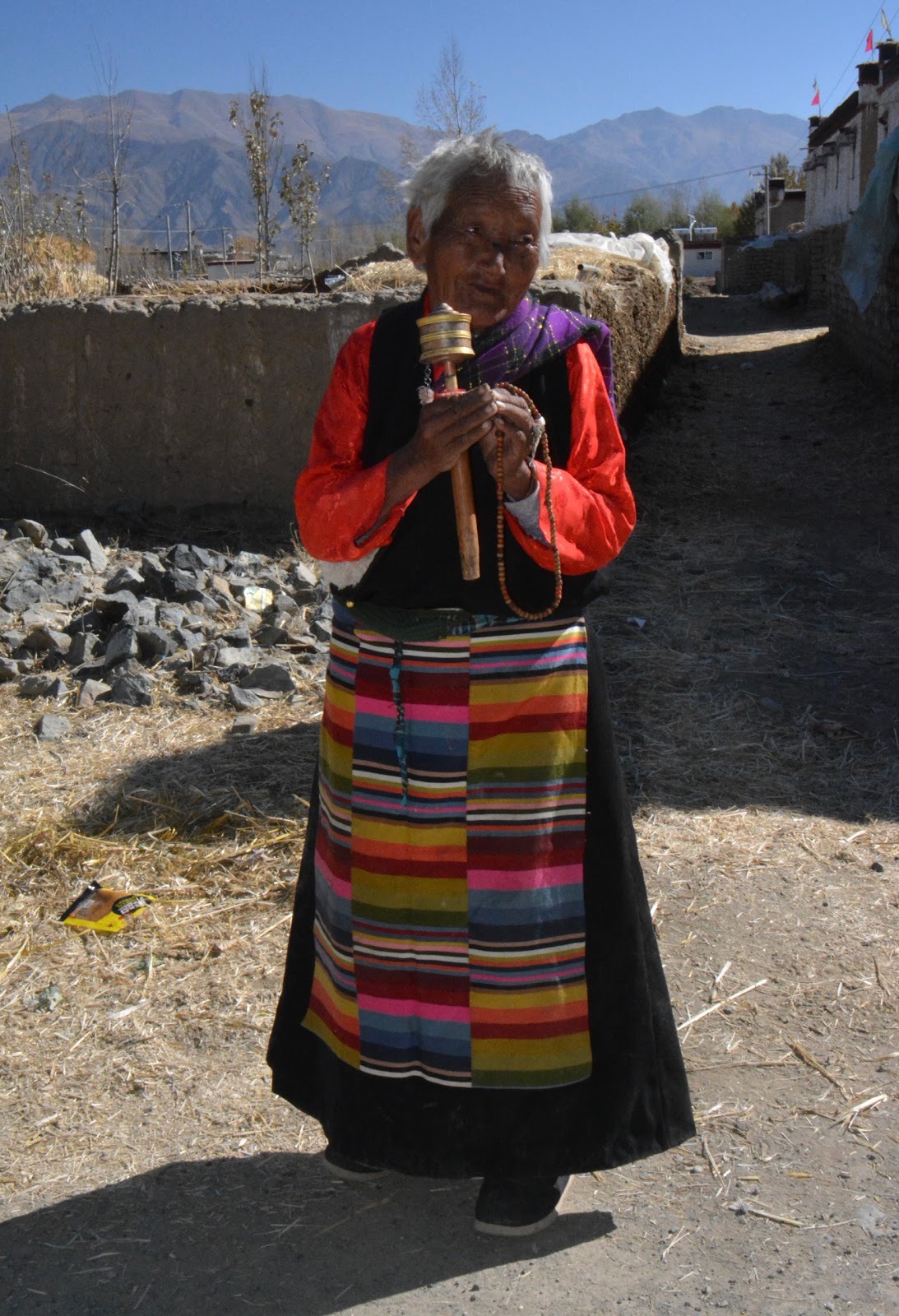
One day Nyima and I walked around an eerily deserted village.  It was a road side diversion intended to while away the time until the next checkpoint.  As we wandered around yak dung houses, we were approached by an elderly woman.  She had a prayer wheel in one hand and prayer beads in the other.  She spoke to Dawa as she looked at me.  She extended her hand, and when I took it, she began to cry.  I looked at Dawa for an explanation.  “I told her you live in America, but you are originally from India.  And she associates India with the Buddha and the Dalai Lama.  I think when she sees you, it reminds her of her unrealized prayers—that she will never see the Dalai Lama in her lifetime.”  I got misty myself, moved by the emotion of the moment.

I had heard something similar when I was staying at the Shangri-La.  A warm and lovely young Tibetan waitress described her fascination with India.  She had always wanted to visit.  She dreamed of seeing the Dalai Lama in Dharamsala, his residence in exile.  She prayed for his safety and long life.  She wanted to visit the sites of Buddha’s life such as Bodh Gaya where he attained enlightenment.  And behind all her aspirations was the wistful sadness of knowing she will never be able to get a passport to go anywhere.

When I was an intern, one of the senior residents nicknamed me “Smiley.”  Somewhere along the line, after all those years of residency and fellowship, being a woman in a male dominated field, struggling to meet all the demands placed upon me, I lost my cheerful demeanor. I developed what is referred to in modern parlance as a “resting bitch face.”  When I was in Tibet, I felt my jaw loosen, my palate relax, my eyes soften.  It’s the face I have when I meditate.  It's Smiley's face.  

Sometimes when I walked by Tibetans, they would look at me and say something to Nyima.  The translation was always the same, “They say you are nice.”  “How do they know I’m nice?” I thought to myself.  One time a donkey started following us, and another time a three legged ram.  “Even the animals think you are nice.” I don’t think “nice” is what they were thinking, demonstrating the inadequacy of language and the insipid nature of that word.  I think they were conveying something like she is “pleasant” or “pleasing.”  

Even now I am struggling to articulate how Tibet changed me.  Something shifted internally.  People often wonder why I choose to travel alone.  I enjoy navigating foreign cultures and languages, keeping my intellect nimble.   “Aren’t you afraid?”  “Don’t you get lonely?”  Whatever doubts I have during my travel pale in comparison to the self I discover.  In traveling I become the person I want to be­­­—smarter, funnier, better looking, all without the benefit of alcohol.  This is the self I present to strangers.  Tibet took that feeling of boldness to another level, where I could glimpse the self I could be—a manifestation of truth and kindness and compassion.  Maybe it was the high altitude, maybe the mindful walking, maybe the rhythm of the monks chanting, but I felt simultaneously energized and serene.  I felt connected to all the beautiful and chaotic humanity around me.


Before I flew back to Seattle, I spent three days in Beijing.  I kept my expectations low, especially after my transcendent experience in Tibet.  Upon my arrival at the airport, my guide John handed me an industrial mask to protect against the air pollution.  I wore the mask most of the time, removing it in the car which had built-in air filtration.  There was a constant haze over the city and suburbs, including at my stop at the Jinshanling portion of the Great Wall, slightly outside the main city.  The tap water was not potable, and I carried a bottle filled with boiled water.  I looked forward to returning to rainy Seattle, where I could drink the pristine water and breathe the fresh air.  I felt sad for the residents who would spend all their days in Beijing. 

My hotel was a converted mansion from the Qing dynasty.  Away from the business district, the hotel was set amongst landscaped gardens and a beautiful courtyard.  It was located in a hutong (a narrow alley) near the Drum Tower and Houhai Lake.  My first few days in Beijing were spent visiting the usual sites—Tiananmen Square, the Forbidden City, the Temple of Confucius, and the Temple of Heaven. At the Great Wall, I watched a young Brazilian man sing “Something” while being filmed for You-tube.  I spent my last night in Beijing exploring the dimly lit hutong.  I took a wrong turn and stumbled upon a bustling street next to the lake.  There were ducks and paddleboats in the water, music and food vendors, children and families enjoying the evening.  I was filled with melancholy for this crazy city that I had just come to know, with its art and history, beauty and chaos.  And for a brief moment, I was a part of it all.    

For more pictures, please go to China and Tibet.

Wednesday, December 28, 2016

Myanmar and what I did there

So I find myself back in Yangon.  This being my second time here, I am already acquainted with the topography of the city. I choose to stay in the thick of it, in Chinatown, walking distance to the hospital.  And like Chinatowns everywhere, it is noisy, dirty, and congested. There are too many cars and too many people.  The smells are pungent, committing olfactory assault on my overly sensitive nose.  Imagine, if you will, a potpourri of fried foods, fishy fish, overripe fruit (durian anyone?), and urine.  I walk carefully, so as not to twist my ankles on the uneven sidewalks, not to step in filth, and not to collide with other pedestrians.  Everything becomes an exercise in mindfulness.

I have come in October, the tail end of rainy season. The weather is hot and humid, making outdoor activity uncomfortable.  In choosing a hotel I had three criteria: air conditioning, Wi-Fi, and free breakfast. Welcome to the Hotel Grand United 21st Street, my home away from home. What makes it “Grand” is the rooftop restaurant from where I survey the city, from the Yangon river to Shwedagon Pagoda.  Shwedagon is the oldest and most sacred of Burma’s pagodas.  Its 110-meter gold and jewel encrusted stupa is the “crown of Burma.”  In contrast, my room is small, austere, and tidy.  The bed is hard and the pillows soft. The staff is helpful and pleasant.

Whenever I move to a different city, I recalibrate my daily activities.  How do I get drinking water, do laundry, buy groceries?  Where do I get a SIM card and top-off my cellphone?  Everything takes longer simply because it is unfamiliar.  And when I find good Indian food, fresh laundry, a nearby park, it is a small victory.  I establish a routine, perform meaningful work, and become part of a community. The shift from being a tourist to being a resident is subtle yet sublime. 

I was last here in 2013.  As both a volunteer and the director of the Orthopedic Overseas program, I have spent six weeks in the last three years in Yangon.  What draws me to Myanmar? What draws anyone anywhere?  I am here to check on the program—to ensure its viability and value for the local doctors and volunteers.  But there is also something deeper, something alive in my blood memory. There are the stories of my great-grandfather, an oil man in Yenangyaung.  Burma was one of the first countries to have a petroleum industry, a fact exploited by both the Indians and British.  My grandmother and eldest aunt escaped through the jungle during the World War II Japanese invasion. There is also my literary memory—Rudyard Kipling poems and stories and George Orwell’s Burmese Days.  In my Chinatown, however, there are no gloved servants, lush gardens, and gin and tonics.  Only the heat and humidity are the same.

Yangon General Hospital, where I spend most of my days, is the national trauma center.  The building is a proud red brick structure, built during the days of the British Empire. Patients are housed in long wards, segregated by gender and medical specialty.  The schedule is well established.  Audit starts at 7:30 am, when the post-call residents present cases from the previous 24 hours. There is review of radiographs, treatment options, and clinical decision making.  My role is to encourage the residents to think beyond classifications systems and to consider the patient’s circumstances.  An American surgeon must undergo a paradigm shift in providing orthopedic care in the developing world.  It is not enough to treat the X-rays.  The patient’s age, nutritional status, pre-existing medical conditions, and living conditions will impact their recovery. Road traffic accidents provide the vast majority of the trauma.  Men and women, children and the elderly, monks and laypeople, all are affected.  There are work-related accidents, such as falls off scaffolding or hands caught in machinery.  And the rare and usually fatal elephant attack. 

I split my time between the General Orthopedic team and the Hand Surgery Team. During my last visit I had focused on general orthopedic trauma.  This involved primarily treating long bone fractures, especially those of the femur and tibia. The preferred treatment here is a SIGN nail, an American implant that can be inserted without use of fluoroscopy (a portable X-ray machine).  This implant, the brainchild of orthopedic surgeon Lewis Zirkle, has revolutionized fracture care in the developing world.  It is an implant rarely utilized in the US, so as an American surgeon I did not have much to teach about its use.  I was more helpful in dealing with complex elbow trauma, an area of overlap between hand and orthopedic surgeons.

With the exception of two weeks in Malawi, I had not operated much in the last six months.  Back in the OR, I supervised the fellows and residents.  I was reminded how much I enjoy surgery.  I delight in the familiarity of anatomy, the challenge of a complex fracture, the satisfaction of restoring the former from the latter. The six month hiatus reinforces that I’m still a decent surgeon.  I have acquired a hard fought set of skills in my 20 years of practicing surgery. If only I could find a (paying) job that allows me to utilize these skills, a job that doesn’t deplete my joy like a Harry Potter dementor.

As my career has become more focused on hand surgery since my last visit, I spent more time on the Hand team.  I was warmly welcomed by the team, led by Prof. Khin Mg Myint.  He is a gregarious, jovial, and insightful professor.  He also never sleeps, often doing multiple digital replantations after hours as part of his own private clinic.  He is rightly revered among the staff and students.  The Burmese hold their professors in high esteem, using the honorific title Sayar (“teacher”) to express this.  There was a ceremony held during my visit in which professors were honored with gifts and food. 

The sharing of food remained a common theme throughout my visit.  I couldn’t walk into the operating room or morning conference without being offered tea, breakfast, and snacks.  It was certainly not because I looked emaciated.  My petite frame was carrying around a Buddha belly from lack of exercise and excess of kindness.  Along with teachers, guests are also honored in this society, and I happened to be both.  As with my own Indian culture, food is a way to express affection.  I was the beneficiary of many lunches and dinners. 

I worked in various settings with different residents and fellows, taking them through challenging cases in the OR, and discussing management dilemmas during rounds.  They in turn drove me between hospitals and clinics. One day the Professor had a couple of the junior residents take me on a field trip to Bago, a historic city about 50 miles away.  We spent the day driving through the countryside, visiting monuments (including a large reclining Buddha), drinking tea, and eating Chinese food.  I felt a little guilty pulling the residents out of their clinical duties, but they didn’t seem to mind the excursion.  

It’s great fun interacting with this team of enthusiastic and energetic residents. They have a well-established hierarchy.  The junior resident is the first one to evaluate and stabilize the terrible injuries that come through the emergency department (ED).  He manages the injuries in the ED, often staying up all night, and then presents the cases to the entire team the following morning.  When I was in residency training, you could always spot the post-call resident.  He was the unshaven, bleary eyed, disheveled one in wrinkled scrubs.  In America, as in Burma, most orthopedic residents are male.  In Yangon, every resident shows up freshly shaven, in an ironed white shirt, with perfectly combed hair.  The Professor does not tolerate alcohol, coffee, or tobacco use in his team.  The residents serve as a testament to healthy living.

After the junior and senior orthopedic residents, you have the hand surgery fellows.  They are more advanced in training, skills, and decision making.  While I try to be impartial, I do have a soft spot for one fellow in particular.  Than Kyaw was a senior orthopedic resident when I first met him three years.  He is a big man with a warm demeanor and is universally adored. His mannerisms and appearance remind me of one of my favorite uncles.  Despite his limited English and my non-existent Burmese, we developed an instant and easy rapport.  In our first case together, we were managing a patient with a wound of the lower leg.  In the US we harvest skin grafts for wound coverage using a specialized instrument called a dermatome. Than Kyaw laughed when I asked for the dermatome, holding up a simple razor blade. “This is our dermatome.”  Whether big cases or small, I was impressed by his skill and confidence.  Three years later, he is now a hand fellow, and greeted me enthusiastically when we met.  He is as friendly as ever, and has taken on the maturity of a more experienced surgeon. I marvel at the invisible bonds which connect us to each other—how relationships can flourish despite differences of language, culture, and background. 

I took two weekend excursions during my time in Myanmar.  For the first, I spent a few days in Mandalay district, visiting the surrounding ancient cities of Ava (Inwa) and Sagaing, and then Mandalay itself.  Nora was my local guide throughout the weekend, and she was a wealth of knowledge about history and culture. Myanmar has had many capitals, including Bagan and Moulmein.  And every capital has an abundance of pagodas. Yangon was the seat of government during British and modern times, until it was moved to Naypyidaw in 2005.  One of the residents succinctly described Naypidaw as a “city with buildings but no people.”  I’ll check it out during my next visit in 2018.  Perhaps it will have a more enticing personality by then.

My second weekend I retreated to the resort town of Ngapali Beach.  I needed a respite from the urban chaos of Chinatown.  I spent most of the weekend walking along the pristine and tranquil beach, watching the sunset, and eating pizza.  I hired a private boat to take me to a few snorkeling sites around the adjacent Pearl Island.  All was going swimmingly until about three hours in, when both my calves inconveniently seized up.  Turns out it is difficult to swim if your legs don’t work.  I signaled to the boatmen who were fishing nearby, and they waved back.   Eventually they recognized my distress (even if they didn’t understand “help me, please!”), throwing me an inner tube, and reeling me in.  Once again I had escaped death by water.

My three weeks in Yangon passed quickly.  I had started growing restless, ready to leave Chinatown for China. 

To be continued…


See pictures at Myanmar 2016